Brochure Printing for Marketing: A Practical Guide From Someone Who’s Been There
Brochure Printing for Marketing, I have not forgotten my initial great brochure catastrophe. We had ordered 5,000 tri-folds to a trade show and the colors of them were not anything like the ones we had approved on-screen. Our bright blue of choice appeared to be purple-shades of gray. It was a costly experience and quite frankly it would have taught me more about print marketing than any book ever would.
Having produced marketing and supervised numerous print campaigns in fifteen years, I have discovered that the aspect of brochure printing has been among the most underestimated aspects to any marketing arsenal. In spite of what digital purists may like you to believe, a professionally printed brochure with good design could do something that cannot be done by emails and posts made at social media.
The Reason why Brochures are still important in 2024.
It has a physical quality to having information in your hands. It has always been proven that physical marketing material produces better encoding of memories as opposed to its digital counterparts. When the person picks up your brochure at a conference or gets it in a sales meeting, he or she is interacting with your brand in a radically new manner.
I have seen prospective clients be able to flip pages on brochures in a presentation, dog ear pages and take them back to their offices. Attempt to make somebody do that with a PDF attachment.
With this said, brochures cannot be deployed as a standalone product. They are supplementary to your digital presence, help to drive the main messages, and also give the prospect something tangible to look at in future.
Selecting the Proper Format of Your Objectives.
Brochures are not all created equal and choosing the wrong format will bring down your entire campaign.
Tri-fold brochures will continue to be the workhorse of print marketing. They are cheap, fit normal envelope sizes and they are brilliant as far as general company overview or service summary. This format is capable of competing in most scenarios in case you are at networking events or have leave-behind material to use during sales calls.
Bi-fold brochures have more canvas to use in cases where you would be explaining complicated offerings. These have been widely applicable to product launches where specifications are important. The bigger panels provide the designers with space to breathe without disintegrating.
The visual drama of gate-folds and accordion-folds can be suitable when dealing with luxury or high stakes dealings. They are however more expensive and need accuracy in application. I usually do them during specific campaigns when the additional cost is self-warranted.
Brochures that are of the booklet type are effective when you need to present a lot of information, such as the capabilities of a company, or annual reports, or an in-depth listing of the products that a company deals with. All you have to do is to keep in mind that the more pages, the more are the printing expenses and content that should be kept up-to-date.
Finish Decisions Paper Stock and Finish Decisions
The perception is influenced by the selection of the paper more than others consider. When I give a person a brochure in which the printing is done on weak paper, I can almost watch my evaluation of our company sink downward.
In the majority of business applications, I will suggest commencing with 100lb gloss or matte cover stock. It is heavy but not extravagant. When you are appealing to a luxury market, or an executive market, increase the weight or the specialty paper.
It all depends on whether you are glossy or not and on your brand personality and practicability. Gloss finishes are eye-catching, photographic and sharp, but have fingerprints and feel rather generic. Matte finishes are classy and minimize glare and, therefore, can be easily read under different lighting conditions.
Uncoated papers have been popular with brands that desire an organic and natural feel. They are especially effective in those organizations that focus on sustainability or artisanship. All you have to understand is that colors will not print hard on uncoated paper, generally they will be a little soft.
The Color Right (Learning From My Mistakes).
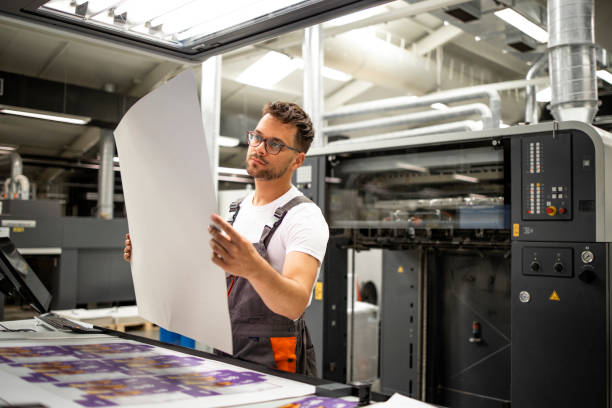
The purplish gray calamity I had said before occurred since I had allowed the colors to be approved on my uncalibrated laptop screen. The professional printers operate in CMYK colour space, whereas the computer monitors utilize RGB. The two systems do not map well.
Always insist on physical evidences prior to giving big print runs. Yes, they do put time and relative expense on your project. They also save you the hassle of re-printing and making humiliating explanations to your boss.
Find printers that are able to match Pantone colors of important brand colors. Pantone spot colors will provide similarity in diverse print jobs and vendors where your logo blue is simply needed to be right.
The Cooperation with Printing Partners.
I have over the years worked with online print firms, local stores and specialty houses. Both of them are beneficial based on your requirements.
Other online printers such as Vistaprint, MOO and PrintPlace have competitive rates and convenience on the usual quantities and formats. They now are much better and can competently do most of the routine brochure work.
When hands-on partnership and timely production are required, quick turnaround or other abnormal requirements, you should turn to local print shops. There is something to be said of being able to walk in and discuss your project face-to-face and look at proofs in person which cannot be captured in pure cost comparisons.
Budgeting Realistically
The scaling of the printing costs is sometimes unexpected by the marketing teams. The initial 500 brochures can be expensive, say 600, and the additional expense of increasing the number to 1,000 may not be that much more, say 150. Such economy of scale occurs due to the fixed costs involved in running the economy of scale plate creation, press preparation, color calibration, etc.
It is however a waste of money to have more than you will consume before you can be informed that it has gone. I have come across storage rooms with expired brochures containing the dead employees, products that were discontinued and old contacts.
Frequently Asked Questions
Which brochure format is the most cost-saving?
Tri-fold brochures on regular paper with the usual common paper stocks usually present the most reasonable price and professional appearance.
What is the time taken to professional brochure print?
Third turnaround 5-7 business days. Rush delivery can be provided within 2-3 days but is very expensive.
Which is the file format to send to the printing?
Most printers in the industry prefer to use high-resolution PDF that contains embedded fonts and CMYK color mode.
What is the order quantity of brochures?
Order what you will give out in a year. It is preferable to reprint rather than have old materials lying idle.
What is the best option, using digital or offset printing?
Digital printing is also good when the quantity is less than 1,000. Affordable larger runs and higher color consistency are made through the use of offset.
And do I absolutely require to demand a corporeal evidence?
Physical proofs should be always desired where quantities exceed 500 or where the color accuracy is important with regard to the job. The low capital investment avoids the expensive errors.